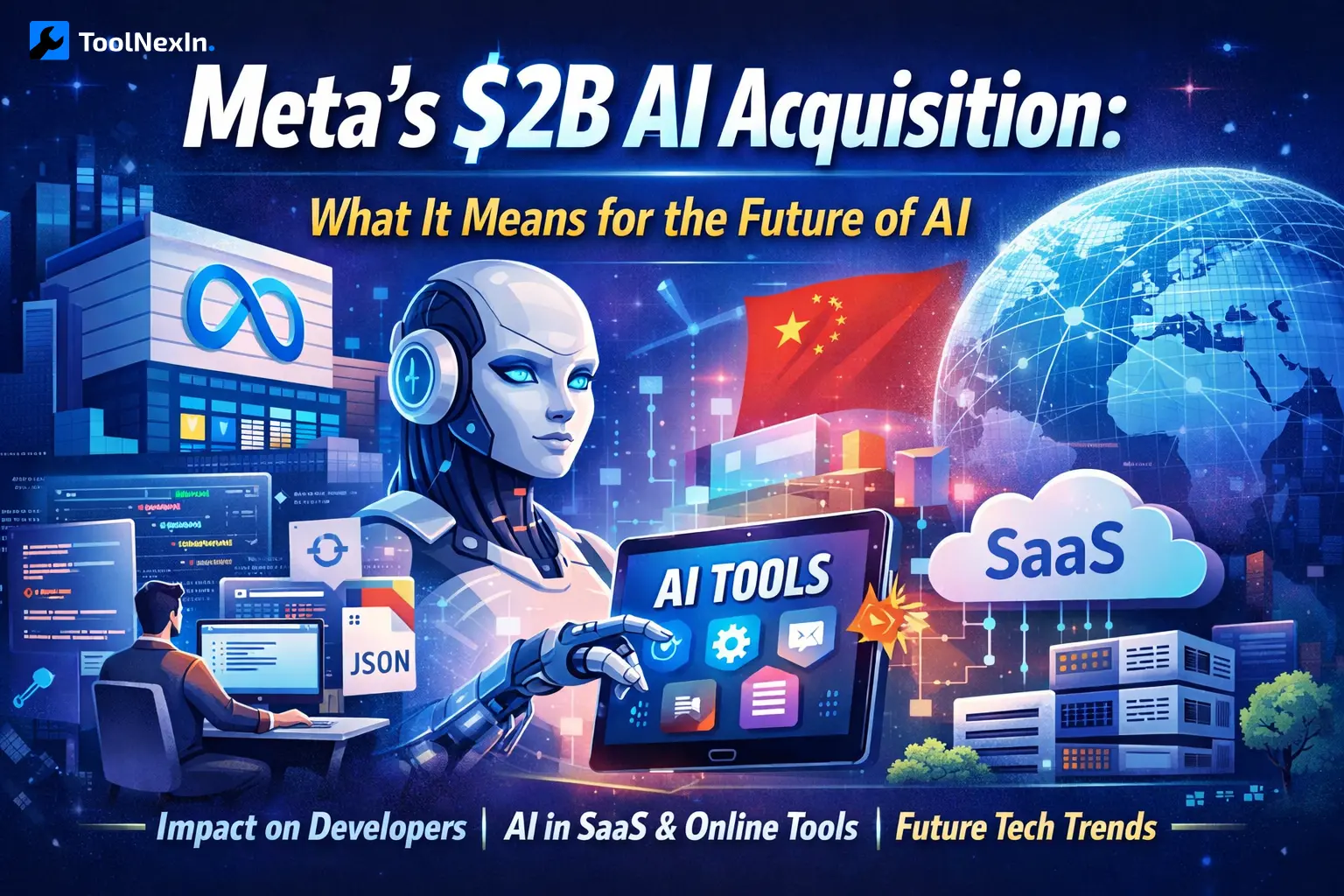
The global tech industry is witnessing one of its most decisive moments. When Meta reportedly committed over $2 billion to acquire an AI startup, it wasn’t just another big-tech headline — it was a clear signal. A signal that artificial intelligence is no longer an experimental feature or a marketing buzzword. It is becoming core infrastructure for the next generation of digital products.
For developers, SaaS founders, and users of online tools, this move has far-reaching implications. From how AI-powered utilities like AI-powered text analysis tools, analyze content quality tools etc., are built to how everyday browser-based tools evolve, Meta’s investment reveals where the industry is heading next.
In this article, we break down what Meta’s $2B AI acquisition really means, not just for Silicon Valley giants, but for:
- Developers
- Micro SaaS founders
- Online tool platforms like ToolNexIn
- Everyday users relying on AI-enhanced utilities
This is not a news recap. This is a future-focused analysis designed to help you understand — and prepare for — the next phase of AI.
Why Meta’s $2B AI Acquisition Matters So Much
Big tech companies acquire startups all the time. But a multi-billion-dollar AI acquisition stands apart for one critical reason: timing.
AI has moved beyond the “early adopter” phase. Enterprises, startups, and individual users are no longer asking if AI should be used — they are asking how deeply it should be integrated.
Meta’s move highlights three important realities:
- AI is now foundational technology, not an add-on
- Speed of innovation matters more than in-house development alone
- AI competition is entering a platform war phase
This acquisition confirms that companies which fail to build or acquire advanced AI capabilities will struggle to remain relevant.
From Social Media to AI Infrastructure: Meta’s Strategic Shift
Meta started as a social networking company. Over time, it expanded into advertising technology, virtual reality, and the metaverse. But AI has quietly become the backbone of nearly everything Meta does:
- Content recommendations
- Ad targeting
- Moderation systems
- AI-powered assistants
- Generative tools for creators
Spending billions on AI tells us that Meta is no longer treating artificial intelligence as a supporting system. Instead, AI is becoming the product itself.
This mirrors a broader industry trend: companies are transforming from “software platforms” into AI-first ecosystems.
The Bigger Industry Signal: AI Is Becoming Infrastructure
One of the most important takeaways from Meta’s acquisition is this:
AI is becoming as fundamental as databases, servers, and APIs.
Just like websites once evolved from static pages to dynamic applications, AI is now evolving from optional enhancement to core infrastructure.
This shift affects:
In the near future, users will expect AI assistance everywhere — not as a premium feature, but as a baseline capability.
What This Means for Developers
For developers, Meta’s AI investment changes the rules of the game.
1. AI Skills Are Becoming Non-Optional
Developers who understand:
- AI APIs
- Prompt engineering
- Model integration
- AI performance optimization
will have a significant advantage. Traditional coding skills remain important, but AI fluency is now a career multiplier.
2. Developer Tools Will Become Smarter
Developer utilities are no longer static. Tools like:
- Code formatters
- Minifiers
- API testers
- Debugging tools
are increasingly enhanced with AI features such as:
- Auto-suggestions
- Error explanations
- Intelligent formatting
- Predictive fixes
Platforms like ToolNexIn are perfectly positioned to evolve in this direction.
3. Speed Beats Perfection
AI-powered development allows faster prototyping and iteration. Meta’s acquisition reinforces the idea that shipping fast and improving continuously is more important than building perfect systems upfront.
Impact on Micro SaaS Founders and Indie Builders
One common fear among small founders is:
“If Meta is spending billions on AI, how can small products compete?”
The reality is the opposite.
Big Tech Validates the Market
Meta’s move validates that:
- AI tools are in demand
- Users want automation
- Productivity-focused software has massive potential
This validation helps smaller tools gain trust more easily.
Small Tools Still Win with Focus
While big companies build broad AI platforms, micro SaaS products win by solving specific problems well.
Examples include:
- A fast JSON formatter
- A smart password generator
- A precise data converter
- A lightweight API utility
AI can enhance these tools without bloating them.
Lower Barrier to Entry Than Ever
AI APIs and open-source models allow solo founders to build powerful tools without massive teams or budgets. What once required years of R&D can now be achieved with:
- Good UX
- Clear use cases
- Smart AI integration
Meta’s acquisition doesn’t kill micro SaaS — it accelerates it.
The Evolution of Online Tools in an AI-First World
Online tools are undergoing a silent transformation.
Before AI:
- Static inputs
- Fixed outputs
- Manual effort
After AI:
- Context-aware tools
- Smart suggestions
- Automated workflows
For example:
- A text tool doesn’t just count words — it analyzes tone and clarity
- A code tool doesn’t just format — it explains improvements
- A calculator doesn’t just compute — it guides decisions
This evolution aligns perfectly with platforms like ToolNexIn.
AI and Browser-Based Tools: A Perfect Match
One overlooked insight from Meta’s AI investment is how well AI fits into browser-based tools.
Why?
- No installation required
- Instant access
- Cross-device compatibility
- Scalable usage
AI running efficiently inside web tools creates massive value for:
- Students
- Marketers
- Developers
- Content creators
This is where future growth lies.
Security, Privacy, and Trust: The New Differentiators
As AI becomes more powerful, concerns around:
- Data privacy
- Security
- Transparency
will grow.
This creates opportunities for tool platforms to differentiate by offering:
- Client-side processing
- No-log policies
- Secure data handling
- Clear disclaimers
For example, AI-enhanced password or text tools must prioritize trust as much as functionality.
How Meta’s Move Shapes the Future of AI Products
Meta’s acquisition points to several emerging trends:
1. AI Agents Will Become Mainstream
AI won’t just respond — it will act. Expect:
- Automated workflows
- Task-oriented AI agents
- Tool-to-tool communication
2. AI Will Be Embedded Everywhere
Users won’t “open an AI app.”
AI will simply exist inside tools they already use.
3. Custom AI > Generic AI
Specialized AI models trained for specific tasks will outperform general ones.
What This Means for ToolNexIn Specifically
Meta’s AI investment aligns strongly with ToolNexIn’s long-term potential.
Why ToolNexIn Is Well Positioned
- Wide range of utilities
- Developer-friendly tools
- Browser-based architecture
- Growing content ecosystem
By gradually integrating AI-powered enhancements, ToolNexIn can:
- Increase user retention
- Improve tool usefulness
- Build topical authority in AI + utilities
SEO Perspective: Why This Topic Is Evergreen
Unlike short-lived news posts, this topic:
- Targets future trends
- Addresses user intent
- Allows deep internal linking
- Supports long-term rankings
Keywords naturally included:
- Meta AI acquisition
- Future of artificial intelligence
- AI tools for developers
- AI in SaaS products
- AI-powered online tools
This makes the article both informative and search-friendly.
The Bigger Picture: AI Is Redefining the Internet Itself
The internet is transitioning from:
- Information-driven → Intelligence-driven
Meta’s $2B AI acquisition isn’t about one company winning. It’s about the next evolution of the web, where tools don’t just respond — they assist, predict, and optimize.
Platforms that adapt early will thrive. Those that ignore this shift will struggle.
Final Thoughts: Opportunity Hidden Inside Disruption
Meta’s massive AI investment may look intimidating, but it actually opens doors.
For developers, it means new skills and better tools.
For founders, it means faster innovation with lower costs.
For users, it means smarter, more helpful online utilities.
And for platforms like ToolNexIn, it means a clear roadmap:
Build simple tools → Enhance them intelligently → Earn trust → Scale sustainably.
The future of AI is not owned by one company.
It’s shaped by how wisely we apply it.
Related Tools on ToolNexIn
Explore these useful tools on ToolNexIn that support modern AI-driven workflows:
- JSON Formatter – Format and validate structured data for APIs and AI integrations
- Code Minifier – Optimize and clean code for better performance
- Password Generator – Create strong, secure passwords instantly
- Text Difference Checker – Compare content changes with accuracy
- UTM Builder – Track marketing campaigns with precision
- Mock Text Generator – Generate realistic placeholder content
All tools are free, browser-based, and require no sign-up.